Tuesday, October 5, 2021

A Year in Retrospect

I ended the last blog almost a year ago with an image of neighbours helping me to load logs to take home for firewood which kept me warm over the winter. A year later it is almost time to fire up the wood burner once again.  Before that I am taking a look back over the past Cobnut year.

November 2020; the dormant catkins are beginning to change to yellow but there is still an autumnal haze over the cobnut plat.


January 2021; a clear day and the catkins are shedding their pollen. It’s still early for the female flowers but that’s not a worry as they must receive their pollen from other varieties and from the wild Hazel’s which are plentiful.  

Catkins blowing in the wind


February and the red female flowers are in evidence and when the weather is dry with a breeze to blow the pollen, they will be fine.  Worryingly the dry days were fewer than the wet and blustery ones so I could only hope for the best.

                                    Female flowers, red stars, visible close to the branch


Meanwhile Tony had coppiced two more of the big bushy wild hazel’s (a new supply of firewood for next winter) and volunteers were willing to come and trim overhanging branches but COVID restrictions intervened. Family help arrived and the work was completed all the same, leaving piles of branches around which Steve, the National Trust ranger from Ightham Mote, turned into manageable piles of chippings in the space of a morning.

                                   Brushwood is chipped. In the foreground, piles of logwood


I had been advised to consider treating the plat to a dose of lime.  It is a practice I remember taking place at least once on my family’s plat (also in Ivy Hatch). A rule of thumb was, I think, once every seven years - or was it every ten years?  So an agronomist was commissioned to take and test soil samples around the plat which revealed that ph levels were indeed low.  Sacks of lime were spread around the trees to be washed into the ground by the rains which followed; while much stayed on the surface it will release slowly over time. A job well done and to be forgotten about for the next seven (or was it ten?) years.

                                                   Lime is spread around each tree


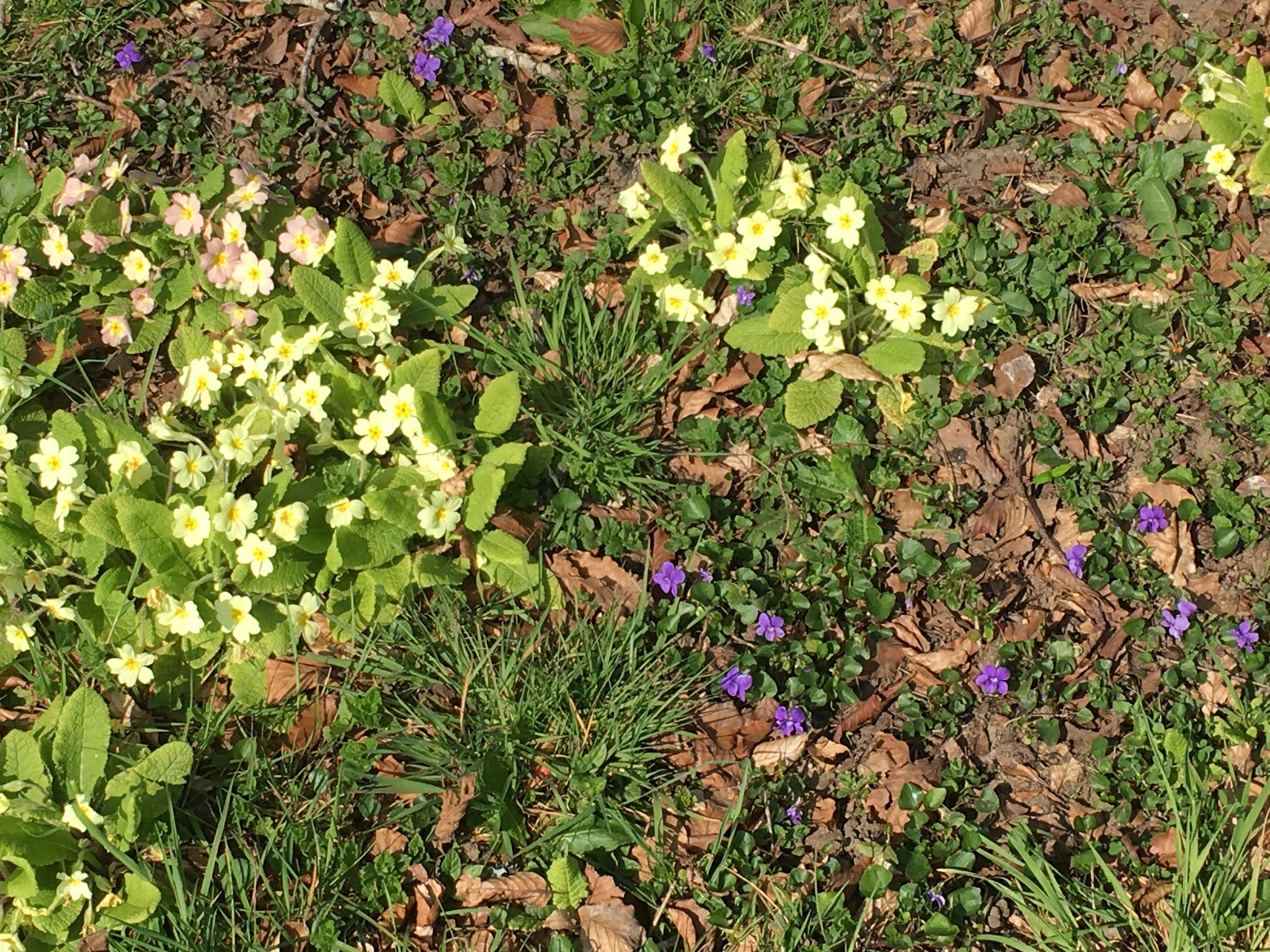
Throughout the spring COVID regulations were still restricting our lives. The ability to cycle to the plat and wander around enjoying the usual display of wildflowers: primroses, violets, followed by bluebells and bugle and culminating with orchids - the common-spotted which flourish in the symbiotic company of hazel - was just one of the ways in which guardianship of the plat has brought much pleasure and relaxation, to myself and everyone who has been part of it over the years.

The KCA’s summer outing had been in abeyance for the obvious reason but we decided to give it a go again and organised a cobnut walk, firstly around the Foxbury plats at Stone Street - taking in a view of the lavender fields as well - and then on the the Mote plat for a wander around and tea and cakes. A pleasant afternoon catching up with old friends.

A gathering of Cobnut enthusiasts

By now the grass was high but that was not a worry for two Irish sisters who came for a look around and a chat in preparation for planting up cobnuts on their family farm in County Antrim. They are not the only ones and it is striking to note the number of farmers and landowners in Ireland, north and south, doing likewise.


knee high in the long grass

Summer mowing was delayed this year for one reason or another. The grass was high in August when the tractor-mower finally arrived and the driver fought his way through it. 


He came again six weeks later for a pre-harvest mow; this time it was less of a struggle.


                                                                           Grass is mown, ready for the pickers

The weeks leading up to the harvest bring the usual worries: will it be a heavy crop or a light one? And will the squirrels be much of a menace? A group of young people from the Tonbridge branch of Young Farmers, organised by Debbie Broad of Mote Farm, came to visit and learn about cobnuts. They must have enjoyed the visit as they stayed until it was almost dark and we could only just find our way out of the plat.

                                        Young Farmers in the gathering dusk

The weekend of September 4th and 5th was ‘Pick and Picnic’ weekend. It was well-attended on both days, friends and families and newcomers arrived in welcome numbers; friends who hadn’t met for a long time, now with young ones in tow, picked and chatted while Charlie provided the finest of picnics with nuts and olives, fruit and the best cheeses from Borough Market, along with generous bottles of red wine.  


Picnic time on 'Pick and Picnic weekend


This sent a few of the company to sleep in the afternoon while the rest continued to pick and to carry crates loaded with nuts and not just nuts……


                                                Taking a rest!


                                                        He has a good crateful

With Charlie in charge, picking on the main bloc continued for the rest of the following week.  Sadly it worked out that the vermin squirrels had taken a large proportion of the lower end of the main bloc, leaving little to be picked.  Disappointing. 


Losses to the grey squirrel vermin have been greater than ever this year.


Meanwhile, the young bloc is reserved for my regular customers and my own use. I spent that week and the next, with help from various friends, in a race against the predatory squirrels. 


The last of the nuts from the young bloc.


It was lovely to be welcomed back to the Mote Visitor Reception area to set up my usual cobnut stall and to be part of the Autumn Celebration in front of the house itself, selling muesli and other cobnut products alongside fresh cobnuts.  

The Celebration of Autumn: stalls in front of the mote.....

                                            ..... and the Cobnut stall


It was, in a way, a swan song as I had decided to give up the baking side of the cobnut project: to ‘hang up my baking apron’ after about seven years.  No regrets and many happy memories!


At the start of October I returned to the plat to check on those layered wands which Tony and I had set almost a year ago.  Of the dozen, half seemed to be doing well.  by excavating the soil around, Tony found that they had not yet properly made roots but were still receiving nourishment from the ‘mother’tree.  That was fine as we reckoned on two years for this to happen and for them to be ready to pot up. We shall see how they are doing this time next year.

layered wands

Thats it for this season and although I shan’t be baking I will continue with the plat and hopefully supplying my regular customers with fresh cobnuts.


Thursday, October 29, 2020

 My last post was in February 2020 and I ended it by noting that the quantity of little red flowers augured well for a good harvest.  In the event the harvest proved to be a fairly average one; not disappointing but not as huge as in 2019. Read on!

Conditions back in February when the flowers were visible were not at all bad for pollination. While there were many rainy days there were also days of calm weather and gentle winds to carry the pollen from the catkin to the flower and that was ideal for pollination.

I have since learned - or come to realise, that pollination is not the same as fertilisation. Whilst pollination takes place early in the year, the pollen is not carried from the stigma to the ovum until two or three months later; and it's not until late May that the little nutkins can be seen.  And if weather conditions are unfavourable - too wet or too cold - then fertilisation can be patchy and result in a high number of 'blank' nuts or nuts disfigured by the unsightly 'brown stain' on the shell, with poor quality kernel or no kernel at all, just brown 'mush'. This year there were a lot like this, due perhaps to a spell of wet and cool weather or possibly to a lack of certain nutrients.  I have arranged for soil-testing to be done this autumn and await the results. In spite of this the 'good' nuts were very good indeed.


This year John W who has looked after, pruned, wanded and mown the plat since the start of restoration in 2011/12, finally retired and has moved north to Herefordshire; he is much missed, not least for his knowledge of cobnuts going back years and also for his love of a good argument about subjects unrelated to nuts and which we could never agree on.  Before leaving he completed the wanding on the main block and I took the decision to omit top pruning for this year.  It would be an experiment to see whether top-pruning in alternate years might be sufficient.

For the young bloc it was the usual routine, Tony did the wanding using our own brush cutter and I with a little help from others did the top-pruning, completed by the end of February or early March.  Then 'lockdown' happened and the prunings, usually collected by students from Hadlow College were still lying around.  Luckily my neighbours with three young children were glad of the opportunity to get out there in the fresh air. They spent several afternoons collecting the prunings, having bonfires and generally letting off steam after a morning of home-schooling.  Thank you to them!

Sales of pea-sticks and bean poles flourished in April, as people turned to their gardens during the lockdown.

The best of the prunings are kept and made into bundles


Peasticks graded by size


April and May, were those months of glorious spring which kept many of us sane and happy. The flowers on the plat were abundant as usual, primroses, violets, bugle, with carpets of bluebells in the woods bordering the plat. 


Horse chestnut in blossom


Twayblade beginning to show its spike

As the summer arrived, in the hidden 'secret' corner below the plat, thistles and nettles were irresistible for crowds of butterflies.  Along with the Meadow Browns and Gatekeepers, numerous Peacock Butterflies and some gorgeous Silver-washed Fritillaries could be found feasting on the nectar in the warm sunshine.


 In April I had  bought myself an electric bicycle and cycled  regularly to the plat to enjoy the peace and calm, not to mention the quiet skies.


In  July it was horrifying to see that grey squirrels were already taking a toll on the nuts even though the kernels were still no bigger than a pea. Once again John W was greatly missed as he was the one to 'take care' (euphemism) of this very real pest.  It seems that a mild winter had meant that the vermin had bred continually throughout the year and were present in the woods in huge numbers. 

 Most other growers that I know reported the same and it wasn't until mid August that I was fortunate to come across someone who would patrol the area and reduce the numbers to some extent. By that stage much damage had been done and perhaps a quarter of the crop on the young bloc and around the edges of the main bloc was lost. The plan for next year is to get on top of the problem a whole lot earlier.


It is never easy to judge when will be the right week to start harvesting.  In this pandemic year preparations for those two weeks included the necessary convenience, reminders for distancing and daily temperature checks on arrival.  I was keen to spare no effort to make things safe.


Fortunately we got the dates  right. The first weekend of September produced splendid weather for the Volunteer Weekend when a good start was made and a picnic lunch was enjoyed by all, distanced appropriately. Distanced picking wasn't difficult given how the trees are spaced at intervals and pickers worked in pairs or family groups.


After that relatively relaxed volunteer weekend the big push came on the Monday when seventeen pickers arriving to work 8.30 to 4.30 on a paid basis. It had been a worry to know whether enough 'home-grown' pickers could be signed up but, thanks to Charlie's website  (www.foodandforest.co.uk),  and to publicity on the Plaxtol Village Facebook page, it turned out well and with a good mix of ages. Apart from one couple who departed after the first day, the pickers soon formed into a cohesive team, working in pairs and keeping up the pace.  The plan was for two pairs to start at the bottom of a row and another two to work their way down from the top.  Meeting in the middle by lunch break was a good target, especially with Charlie urging, encouraging and cheering everyone on.  

Amongst the team were students waiting to go up or to return to university while others were tempted in this pandemic year by the idea of a week's work out of doors in the sunshine in beautiful natural surroundings, and were not daunted by the physical nature of the work. Some came from the local area, others from as far afield as Dorset and Yorkshire.  Picking nuts is certainly preferable to other back-breaking agricultural work such as harvesting lettuces - at least you stay upright on your feet.  


By the end of the week most people found that they had enjoyed it and many would like to come back next year. They will certainly be welcome.


The picking team departed, but fine weather continued into the second week and there was the young bloc still to be picked.  More volunteers turned out to lend a hand and by the end of that second week every last nut had been gathered in - except of course, as someone said, for the ones we missed; but there could not have been many of them.  It has been great to note the quality of the nuts this year: large kernels, sweet and full of flavour and recognised with the award of First Prize in the National Fruit Show 2020.


Now in late October the leaves are coming off the trees, driven by wind and rain.  It is a positive sign that via the Kentish Cobnuts Association frequent enquiries come from folk wanting to purchase young cobnut trees. This should be an opportunity for established growers, and layering is the usual method of propagation. With Tony's help I decided to give it a try and here Tony is seen doing most of the work.  Together we set down a dozen wands and look forward to the results next year in the growing season.   It will take a couple of years to get them to a good size for planting out or selling on.


The final photo shows the return of my kind neighbours who tidied up the plat back in the spring.  Here they are again, loading up logs from previously coppiced pollinator trees to keep me supplied with firewood for the coming winter  months.  Thank you Guys!

Thursday, February 13, 2020

How time passes!

I see that my last post was in winter 2019 and now is mid-February 2020; how did that happen?  the answer is it has been a busy year with not enough time to write up the blog.  I reported that in February 2019 there had been a good showing of female flowers, the little red stars, 'which augurs well for a good crop', I wrote.  And so it turned out to be:  the biggest crop ever in fact and that pattern was repeated around Kent.


At the end of August the trees were laden.  The first volunteers arrived, ready for work and the picking began.  It would continue for the next four weeks whenever a workforce could be gathered.
Those first few weeks of August brought beautiful weather and at weekends friends and family turned out to lend a hand.  The nuts were spread out in the sun to aid drying 
An exciting cricket match on the radio added to the enjoyment and lunch al fresco was good fun and delicious.

The cobnuts were looking good and the regular stall was set up outside the Ightham Mote Visitor Centre


As time passed it became apparent that more help was needed and pickers were engaged by means of an agency.  They worked hard and with good will, gathering in most of the nuts before rain set in towards the end of the month. 


It seemed a shame to have to leave the top corner unpicked; the grey squirrels would be the winners there.  

But before the rains came and while the hot weather lasted the nuts were spread out to dry in the lovely old farmyard of Ightham Mote, by kind permission, for which we were most grateful.

Now it was time to get supplies bagged and boxed for those more-deserving red squirrels in Northern Ireland.  


And then time to get cracking and baking cobnut muesli and biscotti to sell on the stand at the Mote Apple and Orchard Day Fair.


Other varieties beside Kent Cob had done well on the plat this year; Cosford is a shorter nut with a more open husk,

 whilst White Filbert is a small variety, entirely enclosed by its long pointed husk.

Both these varieties would have been planted in small numbers as pollinators for the main crop of Kent Cobs.

Early in the New Year a fantastic team of National Trust volunteers came and spent a day trimming and in some cases coppicing some overgrown wild hazel pollinators.  They worked incredibly hard and told us they had enjoyed their day.  Certainly the amount they achieved was greatly appreciated.  They would be welcome back any time!


***********

In my last blog I wrote about the discovery in the Linnean Society of cobnuts from the earliest years of the 19th century and a correspondence between the grower, Mr Aylmer Bourke Lambert from his manor house in Wiltshire to the founder of the Linnean Society, Dr James Smith of Norwich: Mr Lambert being also a botanist of note in his day.  He began his letter by thanking Sir James on behalf of himself and 'Mrs L' for the fine turkey, which they had served at a dinner party and much enjoyed (I was interested to learn that Norfolk was already famous for turkeys in 1805).  He went on to write about the 'curious tale' of these nuts, sample young trees having been sent to Sir Joseph Banks 'at his particular request'.

Meg and I were intrigued and, having located the village and its manor house on Google Maps I wrote on the off-chance to 'the Owner'.  A reply came back and on an excruciatingly wet day in October - and I think it has been raining ever since - we drove to the village, to be shown round the lovely garden by the gardener and to view, yes, indeed, those nut trees.  At least we dare to hope that the trees we saw are indeed those planted in 1780.  They had clearly been coppiced many times, judging from the width of the base, and most recently just two years ago, so they will not be bearing nuts for another year or two. 


After visiting the garden and seeing from the outside the imposing Jacobean manor house, we went next door to the church which lies right up against the property.  Inside is the tombstone of Aylmer Bourke Lambert, the writer of that letter, and the many other members of his family who lived and were laid to rest in the church over two centuries. 

It was a thoroughly satisfying visit, despite the incessant and heavy rain.  I hope to return later this year and continue the investigation into this intriguing story.

But back to the cobnut plat for a final word and image:-


Look closely to see the little red stars, signals for the coming season's crop.  After the record-breaking harvest of last year we might lower our expectations, but there are plenty of  red flowers and the wind has certainly been blowing the pollen about.  
So, as usual, we wait to see.