Monday, February 20, 2012

Winter continues and so does the work


It's past the middle of February. The pruners have been hard at work and the results are impressive. There is a lot of wood lying around waiting to be dragged out and disposed of!


On the lower bloc at least two thirds of the trees
have been cut back to singles stem


While on the upper bloc it is a similar story.     


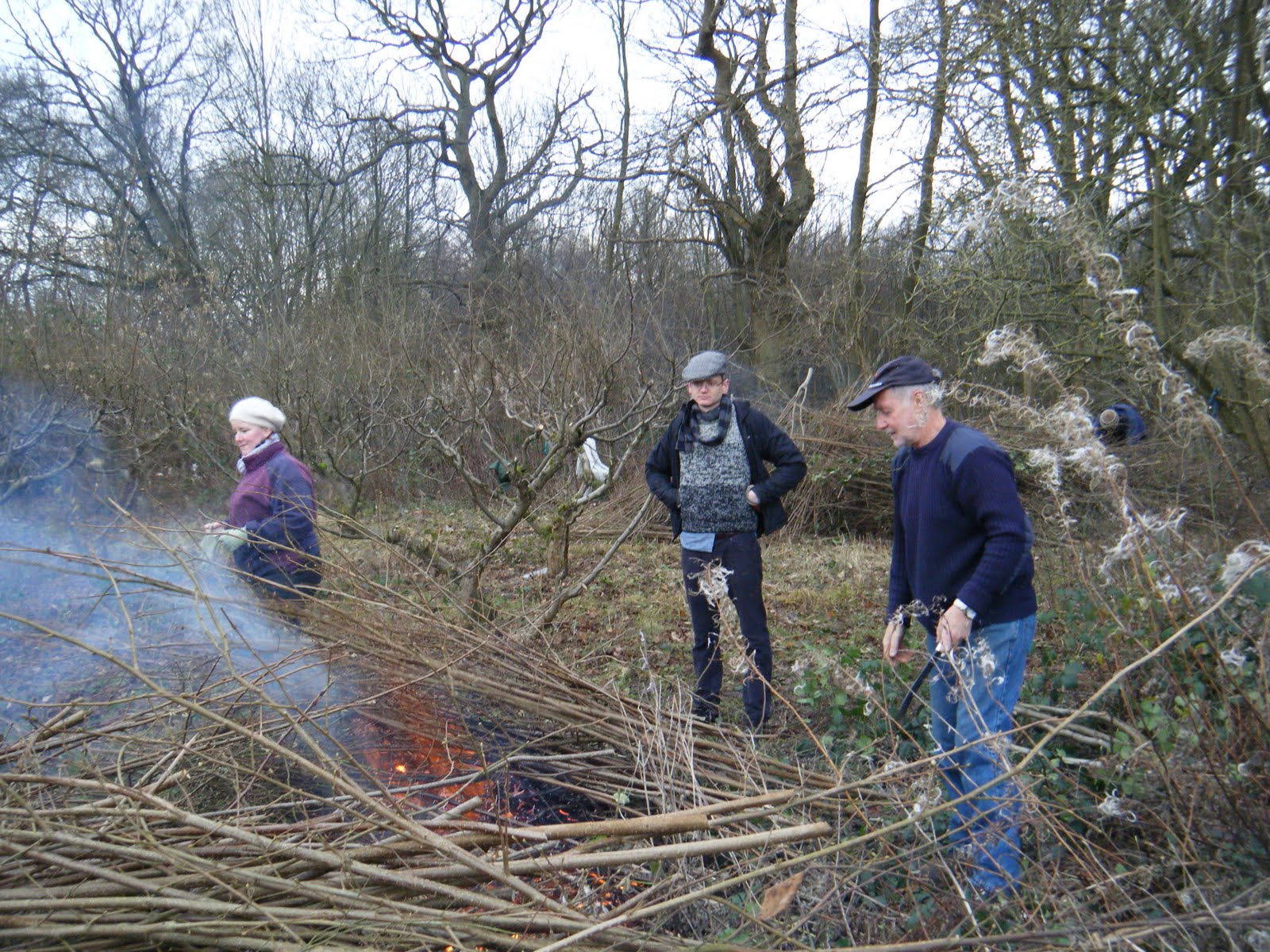
A bonfire is welcome on a cold day,

and a pile of brambles adds crackle!

Not all the prunings are burnt however and this structure will provide a home for bugs and beetles.


we have been lucky with the weather and most working days have been fine.  But at the beginning of February some serious snow arrived and work had to be called off.

At the same time  as the snow arrived the catkins were opening up and letting their pollen float on the wind....


No sign as yet of the females, the little red tassels which produce the nuts.  It is always surprising that the two, male and female, do not usually coincide.  There is some debate as to whether cobnuts are self-fertile or if they are dependent on the wild hazels in the hedgerows to pollinate the female flowers.  We will not know until the summer whether this is going to be a good year for cobnuts.


Sunday, January 8, 2012

Post Christmas Workout

On 29th December eleven of us braved cold, wind and a mainly cloudy day to work off some Christmas excess. Work had been done on several rows of the ‘old bloc’ of trees and piles of wands and prunings lay around to be dragged into piles for burning.


The idea of bonfires was energising and there were new members of the group including some Christmas family visitors who agreed that a day out in the fresh air was what they needed.


Soon a nice fire was burning and, with so much stuff to get rid off a second bonfire was started.

Phew!  It's hot work - how about a break?


At mid-day we took a pause for some really excellent soup provided by two of the group and heated up on a small stove in the shelter of the shed.

 Then it was back to work again.


Apart from a couple of showers, the weather 
remained calm all day.


 Among the nut trees there are some interesting fungi,
 including this ‘fairy ring’ with fungi the size of plates!
 Does it bring good luck to stand inside the circle?


Work stopped at around 3pm and most of the group met again in The Plough.


By 3.30 all that was left of the two bonfires were small piles of glowing ash and embers.

Saturday, January 7, 2012

First Volunteer Day

The first volunteer day was planned for Tuesday December 13th but on Monday the weather was dire.  Gales, already hitting Scotland were forecast to batter the South East overnight and heavy rain was predicted.  Some 10 people were due to meet at 10 am but the outlook wasn’t good.  Fortunately the violent winds and rain passed over during the night and in the morning, although it was still blustery, the skies were clear and washed clean and the sun shone.  


The project had been publicised in the local Seal Advertiser, in two parish magazines, Ightham and St Lawrence, and by the Kentish Cobnuts Association so our number consisted of both local volunteers and some from further afield.

The task was to gather up and burn the prunings and wands which the ‘professionals’ had left lying between the rows.


With the winds still quite strong and the material soaked through from the rain in the night, it was a challenge to get the fire going.  


But they persevered....


And were rewarded with  success.
  

Meanwhile others trimmed branches to a suitable size to feed the fire 


Once the fire was going well the piles of wands, dragged from between the rows of the young bloc of trees, were piled on top and a second fire was started at the lower end of the bloc where there was plenty of material to burn.

Work continued with only a short pause for lunch. A visit from Adam Ford, Ightham Mote’s Head Gardener, and his dog and from Bernadette Gillow, the Mote’s Administrator provided encouragement. Everyone seemed enthusiastic about the project and the day produced a number of suggestions and new ideas.  Several people said they would like to fit in another day after Christmas – possibly to work off some of the turkey and mince pies before indulging again at New Year!

Monday, November 28, 2011

Some two years ago I noticed an ad in 'The Cobweb' - newsletter of the Kentish Cobnuts Association, that the National Trust at Ightham Mote was looking for a new tenant for their cobnut plat.  'Not me' I thought, despite the fact that I had grown up not a quarter of a mile away in Ivy Hatch where my family had a small plat  (or 'plantation') of some 200 nut trees.  In fact our summer holidays had to be organised around when the nuts would be ripe for picking so that the family could be press-ganged into harvesting the nuts.


A year after the initial advert there were still no takers and another ad appeared.  This time I felt I might have a go and went around, in the spring time to take a look at the plat.


It consists of two main blocs, the old
 and long-established trees, with an
open space and an old shed in front....


....and a bloc of more recently-planted young trees.


The wild flowers were spectacular


and a survey, later, found fifty two different plant species.


but it was getting very overgrown and work would have to start soon or it would become a jungle


With the encouragement of friends and family, and having recently been invited onto the committee of the Kentish Cobnuts Association, I decided  I had enough support and I would go ahead. This meant talks with the National Trust, drawing up a management plan and work to find funding to kick-start the project.

*****

Towards the end of October the green light was received for the Ightham Mote cobnut restoration project to go ahead. Three thousand pounds of matched funding was to be made available from European Intereg4 funding, channelled to us via the Medway Valley Countryside Partnership working with Kent County Council. In effect this meant £1500 from MVCP to be matched with another £1500 to be raised by the project. This has been achieved with the support of the National Trust at Ightham Mote, the Kentish Cobnuts Association and private sponsors. As the matched funding is only available until the end of 2011 it was important for work to start straight away.  And there is plenty to be done.

The skilled work consists of pruning the trees, taking out the accumulation of unwanted growth, and bringing the trees back to the traditional shape where a limited number of branches bear the twiggy ends which will carry the harvest of nuts. This calls for experts, skilled in the knowledge of traditional cobnut cultivation which is what the funding will pay for.


Old trees, overgrown with young wands


Alongside this is the work of collecting and burning the prunings, clearing the thickets of brambles which, in many parts of the plat have grown into a tangled jungle and tackling the many small (and some by no means small) 'sports' of birch and willow which have taken advantage of the last few years of neglect with ambitions of their own to turn the place into a scrubby woodland. They all have to go.


By mid-November 2011 work had started, firstly on the lower of the two blocs of nut trees. These are quite young and recently-planted but  they have been left untended and a mass of wands has grown up around the original sapling, to the extent that it's almost impossible to see which is the original stem. However, the original - or what looks like the original - is selected and the rest are cut out.

                             Young trees before.....


....and after pruning has started.

At the same time work started on the upper bloc, the older trees. Here the main branches are easily distinguished but there is a lot of surplus growth which needs to go.


*****


The days have been mild in November which means

on some days fogs


....and on other days glorious sunshine which turns
the tips of the leaves golden as the sun goes down.                  


Those golden leaves however are mostly birch
sports and they too have to come out!