Wednesday, May 15, 2013

Spring At Last!

As I write this in May the flowers on the plat are in full bloom.
Primroses between the rows

Carpets of violets
Bluebells in the woods

April was a busy month, with two school visits. First to come was Shipbourne Primary.
  
SHIPBOURNE PRIMARY SCHOOL
Teachers, classroom assistants and  helper Mums accompanied the entire school - all 56 of them - Key Stage 1 and Key Stage 2 children.  I was especially pleased to welcome them as my own children are 'old boys' of this school and I have fond memories of that happy time.
The children arrived on a damp and misty morning

They split into groups to visit six different points on the plat for a variety of activities and exploration  guided by a volunteer.  The children joined in the activities with enthusiasm.


At the end of the morning the children were ready for their packed lunches.....

 And the volunteers lined up for a photo-opportunity.

Then it was time to leave
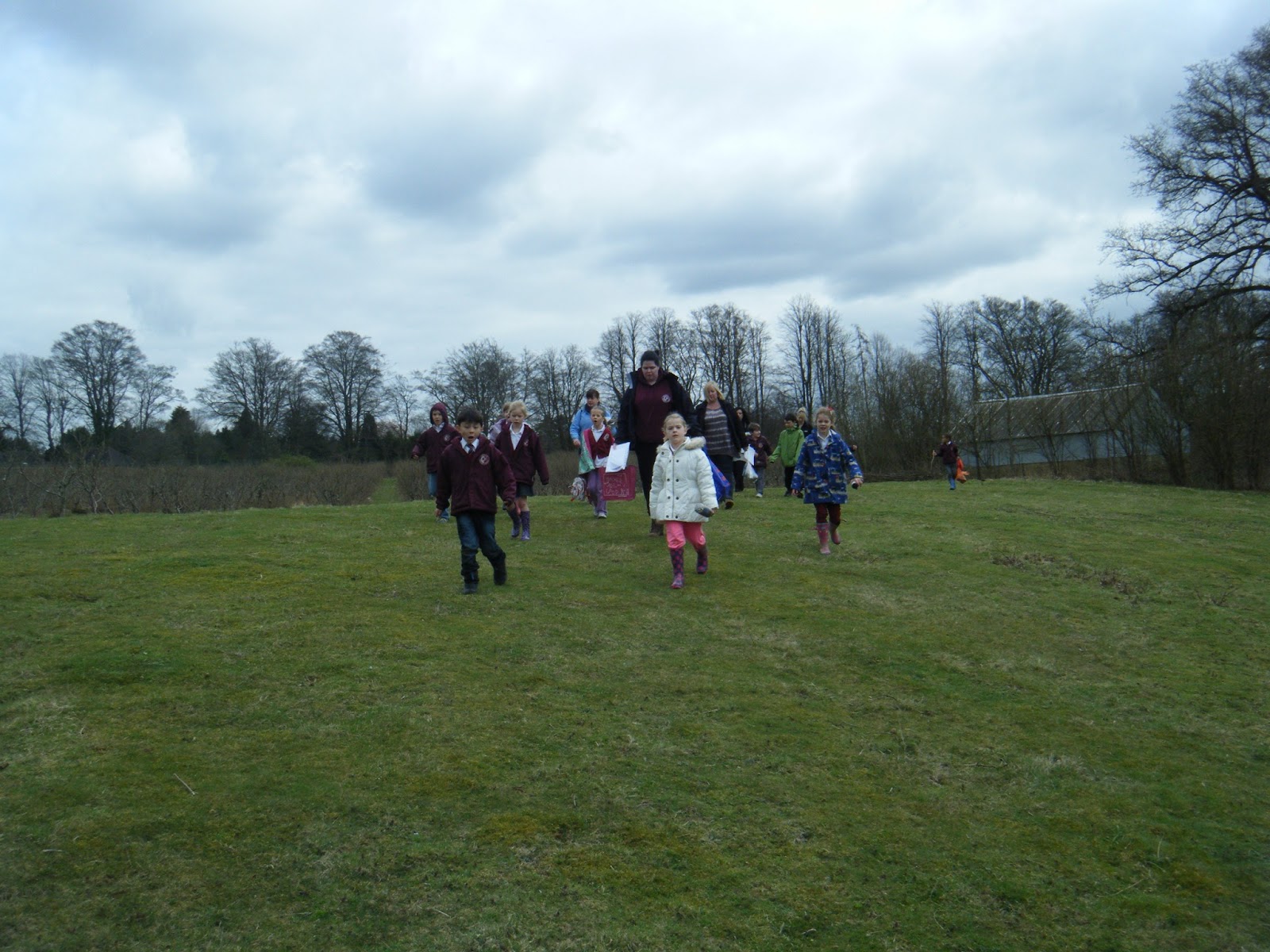
....and there was plenty of energy left for a run down the hill....


....before setting off on foot for a muddy walk, past Ightham Mote and across the fields to Shipbourne.

The teachers reported that all returned safely, tired - especially the little ones - but happy with their day.  The children sent lovely thank you letters and told us about the things they had enjoyed most on their day at the plat.

IGHTHAM SCHOOL
Later the same week we welcomed  'Chestnut Class' 
from Ightham Primary School, children of Key Stage 1.


Susanne, who designed worksheets and guidance notes for both school visits, had the children fascinated by mini-beasts, fungi and rabbit holes.


The children from both schools collected treasures and trophies which included nuts that had been nibbled by mice or squirrels - and by the end of the morning the children could tell the difference.  For some children the experience of weaving a bug hotel with Tony was the highlight of the day, for others it was finding a hawk-moth with Penny,  looking at spiders' webs and a wasps' nest with Carole or making a guess at the number of nut trees on the plat with Richard. We think they all found something interesting and memorable to give a special bond with the natural world.


Look what I found!


Counting heads!
Soon it was time to line up and count heads before returning to school and we hope they will come again!

A SAMPLE OF THE THANK-YOU LETTERS AND DRAWINGS FROM THE CHILDREN


THANK YOU FOR YOUR LETTERS!

Thanks also, and especially, to Susanne for preparing the ground for the visits with guidance notes, worksheets and activities. They are resources which we now hold for use and adaptation for future school visits.  

Friday, March 29, 2013

Winter 2013 Continues

Despite what the weather threw at us much work was completed on the plat between the end of January and the end of March.  The main task of cutting out and clearing willow, birch and ash saplings had been completed but the back-aching job of 'wanding' i.e. cutting out the young wands, remained. New wands grow each year but they had done so with renewed vigour following the hard cutting back last year.  The Ightham Mote Garden Team and their volunteers  joined with us on the task but  it takes a long time to clear just a few rows by hand: 
'White-out'
 Snow arrived and stopped work,                   


.... turning the site into a white wilderness.


In February the professional pruners were at work again top-pruning those trees which had not been done last year.
With pruning saw ....

.... and secateurs


The catkin is out and a good showing of the tiny red stars, the female flowers which produce the nuts.  It was good to have a few fine dry and sunny days when the pollen from the catkins could drift and pollinate.


The tiny, star-like red flowers will produce nuts

In fact the great show of catkin on the plat is less important than the pollen that comes from the wild hazel in the hedgerows and from those pollinators growing among the cobnuts, because the variety we grow here, the 'Kent Cob' - also known as 'Lambert's Filbert' - is not self-fertile and needs the pollen from other varieties or from wild hazels, to produce a crop of nuts. 


Variety 'Kent Cob (or 'Lambert's Filbert) is not self-fertile;

....it relies on pollen from  hedgerow hazels or pollinators

A great show of catkin


A wild hazel pollinator on the plat


With plenty of female flowers this season we can only hope that conditions were right and for long enough, to produce a crop in August/September.  That will also depend on conditions in forthcoming months as well.


Bean poles ready for the garden


A quantity of strong, straight wands have been rescued from burning. They  will be made up into bundles to be sold as poles for runner beans to grow up, at gardening and allotment societies and to keen gardeners -  raising funds for the summer work of mowing.


Will it light?
Burning up the debris of birch and willow was carried out in February and into March. 


Although snow again intervened it did not hold up the work unduly.


The bonfire takes off despite snowy conditions

Most of the wanding still remains to be done and in the third week of March help is on hand again from the National Trust.  The Trust runs Working Holidays - formerly known as 'Acorn Camps',when volunteers
spend a week working on projects.  This time they offered us a day out of their week and turned up in good time.  
Team leader and volunteers on their 'working holiday'

Wanding is not the most exciting task but they took to it cheerfully and got through a good number of rows whilst taking a keen interest in the history of the plat and the cultivation of cobnuts in Kent.  They made a terrific contribution and hopefully will have taken away some new knowledge and interest from their day.


Most of the trees which were top-pruned last year have not had the treatment again this year with the exception of the lower bloc of young trees which I've taken on as a pet project to try to re-shape them into the traditional 'open goblet'  structured style.


Pruning with secateurs

.... and with pruning saw

Blue flag shows the next tree to be done


At the top of the plat the estate's Ranger and his team have provided a new fence to replace the old and, in some places, non-existent one alongside High Cross Road. 


There will soon also be a new gate to replace the old one.


At the end of March we are still - despite the date - enduring bitterly cold winter weather.  Some primroses have bravely started to show their flowers....
Testing the air?
....not risking it


....while others are keeping a low profile. 


I'm hoping for warmer conditions after Easter when we look forward to welcoming two school parties on separate days.  More of that in April.

Sunday, February 3, 2013

Learning to prune cobnut trees

The Kentish Cobnuts Association offered a pruning training morning in January. Just four of the Nutters group went along to Roughway Farm at the invitation of John Cannon and Giles Cannon to learn from experts and improve their skills.


The session started with coffee and an illustrated talk in the oast barn where John Cannon  pointed out some characteristics of cobnut trees and their pruning, as well as giving us some history of cobnut growing in Kent.

We then moved outside to visit  a number of different plats around the farm, in various stages of development and conditions.  The first was a group of mature Kent Cobnut trees - probably over a hundred years old where the nut-bearing branches needed thinning to let light into the centre of the trees. This was an opportunity to get 'hands on', using pruning saws, loppers and secateurs, with benefit of advice from the Cannons, father and son.
Kent Cobnut trees, between 100 and 150 years old

The second stop was a more recently-planted area, mainly of the variety Butler. Giles Cannon demonstrated the use of powered secateurs with which he made extremely fast work, using a battery back-pack, taking out the wands at the base of the tree as well as working rapidly through the nut-bearing branches, removing any dead or crossing-over branches and thinning the rest to produce more substantial nuts and to let the sunlight in to ripen the crop.  We were reminded that the leaves, which can be as big as a small plate in summer, will prevent much of the light from getting to where it is needed and this is why the open goblet shape is necessary for ripening the crop.
Wands have been stripped from the base of the tree using powered secateurs. from fairly recently-planted 'Butler' variety


The third plat visited had recently been taken on by the Cannons and contained trees which had been 'let go' for some considerable time. It was interesting because it resembled the state our own nut plat had been in when work started in 2011/12 and the approach to bringing it back into productive form was similar.

It was an interesting morning and an opportunity to meet other growers from around Kent and beyond. Well done to those brave and hardy souls who dressed up warm and braved the biting winds.

Dressed to beat the cold


Thursday, January 31, 2013

The new year brought welcome news that the Ightham Mote Garden team, four professionals plus volunteers, would be giving us five days of their working time in January.  Dates were arranged, spread throughout the month. On the first of these, volunteers from our regular Nutters joined with the Mote gardeners and volunteers.
Ightham Mote garden team and volunteers


The plan was to take out as many of the birches, willow and ash saplings as possible and to work across the rows, trimming back the nut trees at the same time, just enough to allow the tractor-mower to work across as well as down the rows.


 In this way it is hoped to keep the saplings from sprouting and growing back and to keep the brambles down.   Although spraying has been used in the past for bramble control we are hoping to avoid this if possible on grounds both of cost and environmentalism.

With the additional help work went ahead faster than I would have believed possible.  By the end of the third of the five days all the rows had been cleared, thanks not least to the contribution by our chain-saw expert and some very energetic work by all concerned, using nothing more than pruning saws and loppers.

We enjoyed some good weather and one especially lovely frosty morning.

Lovely frosty morning


Then came the snow and work on that day had to be abandoned.


Catkins are beginning to unfurl in the more sheltered parts of the plat but it is too early still for the red-tassels of the female flowers to appear. One or two daring primroses have also been spotted.


On the last day with the Mote team we worked mainly on taking out the young wands which have grown with much energy since the major cutting back of the previous year.  Clearing the rows of saplings has left large quantities of brushwood to be dragged out and burned.  That and the seemingly interminable job of 'wanding' will keep us busy in the coming weeks.

Wednesday, January 2, 2013

End of Year 1

In October John,our 'professional', returned to cut overgrown wands out from the remaining dozen or so rows on the road side of the plat, and Carol came in soon after to top prune those trees.  This meant that once again the rows were filled with the familiar sight of piles of cut wood which would have to be dragged out and disposed of by bonfires


But help was at hand;  Maria from K-College had asked to bring her group of students with learning disabilities to see if there was an opportunity for outdoor work.  They came, with Mark driving the K College minibus, on the first Monday in November and pitched in with gusto, making a good start on the dragging and burning.


Maria then emailed to ask if they could come every Monday in November and this request was quickly agreed to. Their enthusiasm was infectious and the regular team and the students all got on like a house - or pile of wood - on fire.


By the last of their Mondays all the wood had been cleared from the rows and burned or sorted, the longer poles to be bundled up and sold in the spring as 'bean poles', the rest turned into small piles of ash.


This was very much what the vision of the plat is all about, i.e. creating volunteering opportunities for  all sorts of different groups.  In this case the students had loved the challenge and completed an amazing quantity of work and the regular team had enjoyed showing them how -  helping them and encouraging their efforts and the interaction had been profitable for everyone concerned.  K College Students: 'We loved having you and hope you will be back in the spring (there will be plenty more to do!)'


Hot on the heels of the College students we were helped out, on a very, very wet day, by a combined group from VAWK (Voluntary Action West Kent) and the Green Gym of Ashford plus tcv volunteers and we also welcomed new volunteers from Ightham itself. 


On this occasion we tackled the wands and the unwanted saplings of the lower young bloc of nut trees and, until the downpour stopped play just short of completion we had finished the work on 99.9% of that area   (the rest to be polished off by our Ightham volunteers the following week)


And so into December - a year almost to the day when we had started work in 2011.  We began work again on the main bloc, cutting out wands and clearing saplings and were joined on one occasion by the Mote Gardeners Team who have promised to come and spend more time with us in the new year.  They will be most welcome as, frankly, the amount of work is intimidating and we may have to compromise on what we can get done in the coming year.


Nothing daunted however, a 'post-Christmas workout' was planned for December 28th.  Few of the regular team were able to join in this time and the weather was looking dire.  It turned out drier than we had feared and five of us set about eliminating those unwanted saplings from between the trees, dragging and dropping onto piles for burning later, when the weather dries out, and working off some of the Christmas excess.


All of which brings us to the end of 2012, a year in which, thanks  partly to the very dry conditions of December 2011 to March2012 , an enormous amount was of work was completed on the plat.  But, due probably to the squirrel problem, not much of a crop was harvested in September and plenty more work remains to be done. This was always going to be a 3- or 4-year project and there is no reason to despair: at least no reason apart from the squirrels, which take more than half the crop.  And if anyone has an answer to that problem we would very much like to hear from them.